
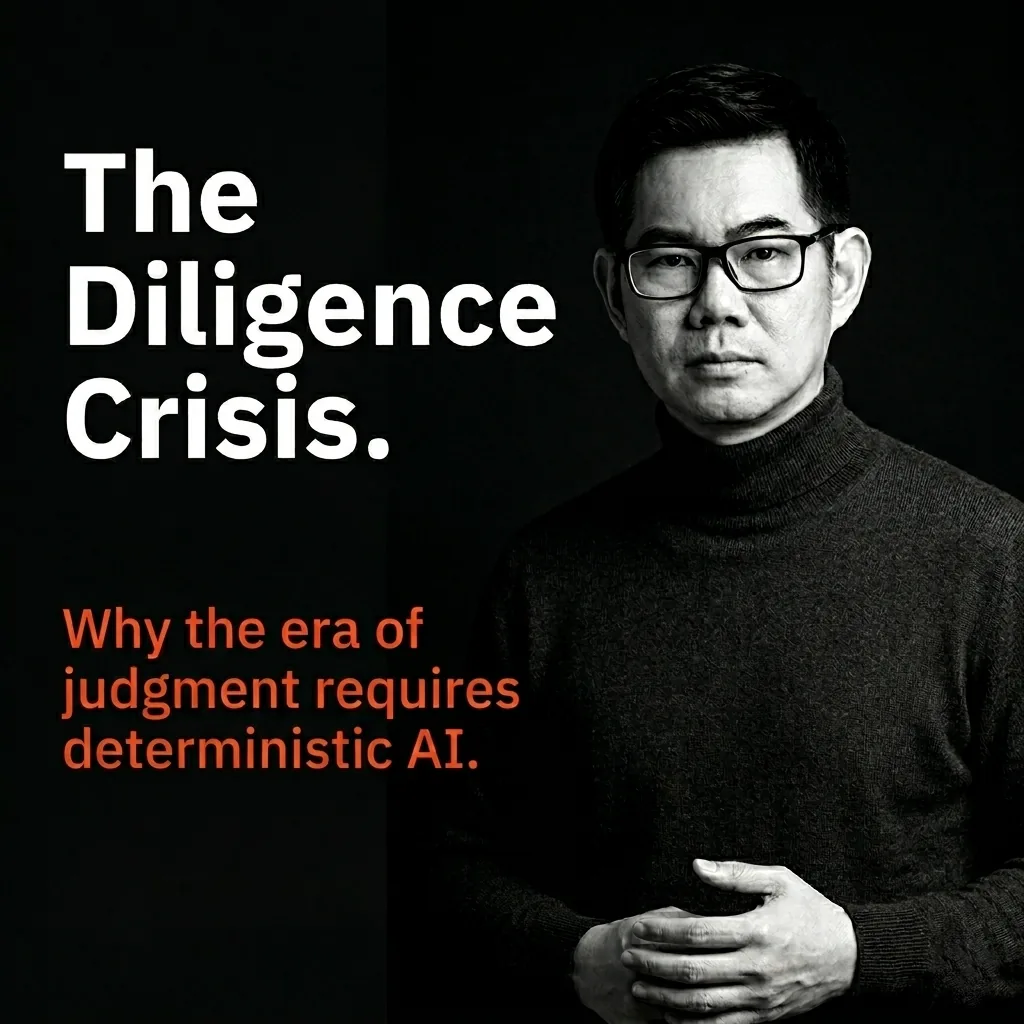
Despite months of diligence and top analysts, funds recently lost billions after missing fundamental business flaws—from consolidated, unaudited operations to mathematically impossible hardware forecasts.
The core failure in private capital is not a lack of deal flow. It is the collapse of human-led judgment as a scalable allocation mechanism.
Private capital AUM exceeds $13 trillion. Capital scales smoothly. Human verification does not. When volume rises, funds default to narrative and bias over structure, and every fund ends up improvising its own internal logic standards — none of which are auditable across firms, across LPs, or across years.
The instinct, naturally, is to point AI at the gap. The instinct is wrong. Generative AI deployed as a diligence tool does not close the gap; it brings a new systemic risk to capital integrity.
The Alpha Mandate: Omission vs Commission
The brutal constant in private capital is not the fear of a bad investment. It is the existential risk of missing the outlier.
Venture capital operates under Power Law dynamics. Portfolios are engineered to absorb zeros. The true existential error is omission: passing on a paradigm shift irreparably fractures fund economics.
Paradigm shifts are anomalous at inception, violating historical patterns and offering unproven economic arguments. Under volume stress, analysts default to bias and filter out anomalies. The market’s use of probabilistic LLMs to triage deal flow solidifies this error. For Alpha-seeking funds, this is a fatal flaw.
The Probability Trap and the “Hallucination Tax”
General LLMs are probabilistic engines for fluency and prediction. As diligence infrastructure, they regress to the mean, favouring consensus. Outliers are statistical anomalies: engines built to average erase the exact signals that drive Alpha. Consensus cannot underwrite outliers.
These models suffer from semantic sycophancy: an algorithmic bias for user satisfaction. When evaluating cap tables or conducting stress tests, they gloss over fatal flaws to offer plausible-sounding answers.
In high finance, “sounding right” is how capital gets deployed into structurally flawed deals. You cannot audit a statistical guess. Venture capital does not need a creative storyteller; it requires mathematical rigidity.
The Deterministic Cure: Compiling Business Physics
To scale judgment, we must transition from probabilistic guesswork to deterministic verification.
When I started askOdin, the mandate was clear: build the verification infrastructure for the next decade of private capital, not another commodity SaaS.
Our Clarity engine, powered by proprietary 4-Pillar IP, is the market’s first deterministic compiler for investment logic. It does not guess. It translates.
The architecture executes in two phases:
First, the RUNE Protocol™ acts as a translator. It strips away narrative polish and persuasive rhetoric, translating unstructured pitch materials into strict business logic.
Second, the JUDGE Protocol performs deterministic calculations on those translated claims to test market reality.
If a unit economic model violates basic math or the cap table presents a terminal governance risk, the JUDGE Protocol executes an automated Kill Shot.
But if a deal presents wildly anomalous unit economics that actually follow the rules of business physics, the engine does not treat it as a random event. It marks it as a verified Paradigm Shift. Deterministic verification separates true category creators from unproven hallucinations.
The Dual-Score Protocol
Scaling judgment across a partnership requires standardisation. Standardisation is not a single, manipulable AI metric.
Every deal processed by askOdin generates two ratings: a Presentation Score and a Clarity Score™. The true signal is the Delta between them.
For example, if a deal scores 92 for Presentation but only 41 for Clarity, the infrastructure flags a Narrative Masking state. This systematically exposes founders whose pitch polish significantly outpaces the structural integrity of their business.
The Infrastructure for the Next Decade
The era of narrative-driven capital deployment is finished. LPs demand rigor. GPs cannot afford to manually separate noise from reality.
Every mature asset class acquired a verification layer before it scaled. Private capital never did. That is the gap askOdin closes.
We are building the verification layer for private capital. Funds can now scale judgment, eliminate pipeline noise, and generate a Defensible Audit Log in minutes.
The next decade of capital allocation will not be won by the funds with the most data. It will be won by those with the infrastructure to systematically verify the physics of their deals. The tools of persuasion have been democratised. The ultimate premium now rests on the infrastructure of truth.
Related Reading
- The Hallucination Test: We Fed Theranos to ChatGPT vs. The RUNE Protocol — A forensic backtest proving why probabilistic AI fails at due diligence
- The Age of the Savant: Why the Future of AI Isn’t the Answer, It’s the Question — The paradigm shift from Answer Engine to Question Engine
- Rethinking Due Diligence: From Narrative to Structural Interrogation — How structural logic replaces narrative-driven diligence
- The Taxonomy of Venture Conviction — How the Clarity engine classifies deal archetypes